Sapodilla
Sapodilla Fruit Trees
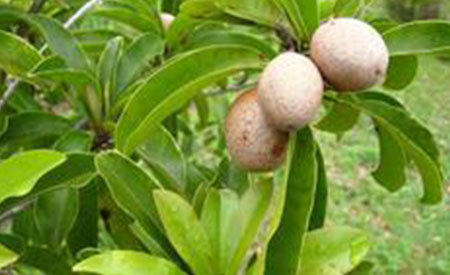
The sapodilla is a fairly slow-growing, long-lived tree, upright and elegant, distinctly pyramidal when young; to 60 ft high in the open but reaching 100 ft when crowded in a forest. It is strong and wind-resistant, rich in white, gummy latex.
The sapodilla grows naturally in the calcareous marl and disintegrated limestone of its homeland, therefore it should not be surprising that it is so well adapted to southern Florida and the Florida Keys.
Nevertheless, it flourishes also in deep, loose, organic soil, or on light clay, sand or gravel.

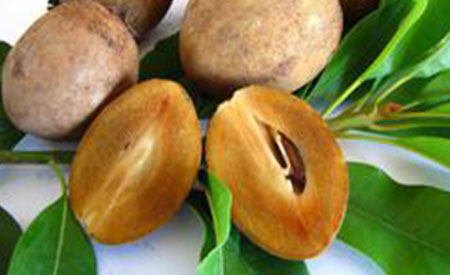
The fruit is a fleshy, 4- to 5-celled berry with a waxy surface. Fruit are 2 to 6 inches (5-15 cm) in length, with 5 (rarely 4-8) prominent longitudinal ribs. They are star-shaped in cross section. The fruit skin is thin, light to dark yellow, and smooth, with a waxy cuticle. The pulp is light to dark yellow in color, translucent, crisp, very juicy, and without fiber.
Generally, the ripe sapodilla, un-chilled or preferably chilled, is merely cut in half and the flesh is eaten with a spoon. It is an ideal dessert fruit as the skin, which is not eaten, remains firm enough to serve as a “shell”. Care must be taken not to swallow a seed, as the protruding hook might cause lodging in the throat